Steam‑Generation Parallel Modular Seawater Desalination Unit
Overall Equipment Scheme
This equipment is an integrated cavitation steam-generation seawater desalinationunit housed in a 40-foot standard container. Six independent cavitationsteam-generation desalination modules are installed inside the container. The wholeskid-mounted system consists of main cavitation steam-generation units, vapor-liquidseparation units, heat-exchange & condensation units, pre-treatment units andelectric control system. It is equipped with an external auxiliary solar power interface.The complete unit can be transported as a whole and put into service after on-sitepipeline connection. It is a modular off-grid equipment for treating high-salinityseawater /brackish water and high-salinity wastewater.
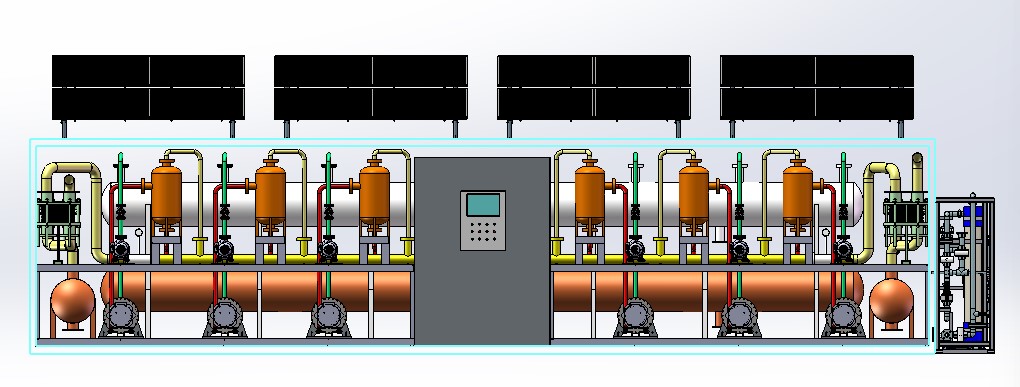
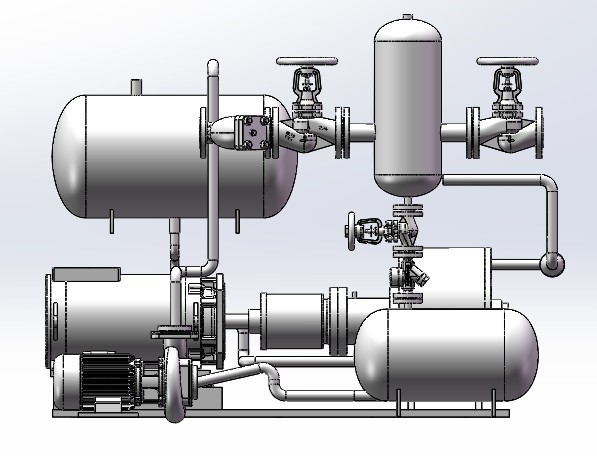
Single module: supporting motor power 120 kW, clean steam output 2 tons per hour per unit.
Number of modules: 6 sets of cavitation steam generation modules arranged in parallel inside the container
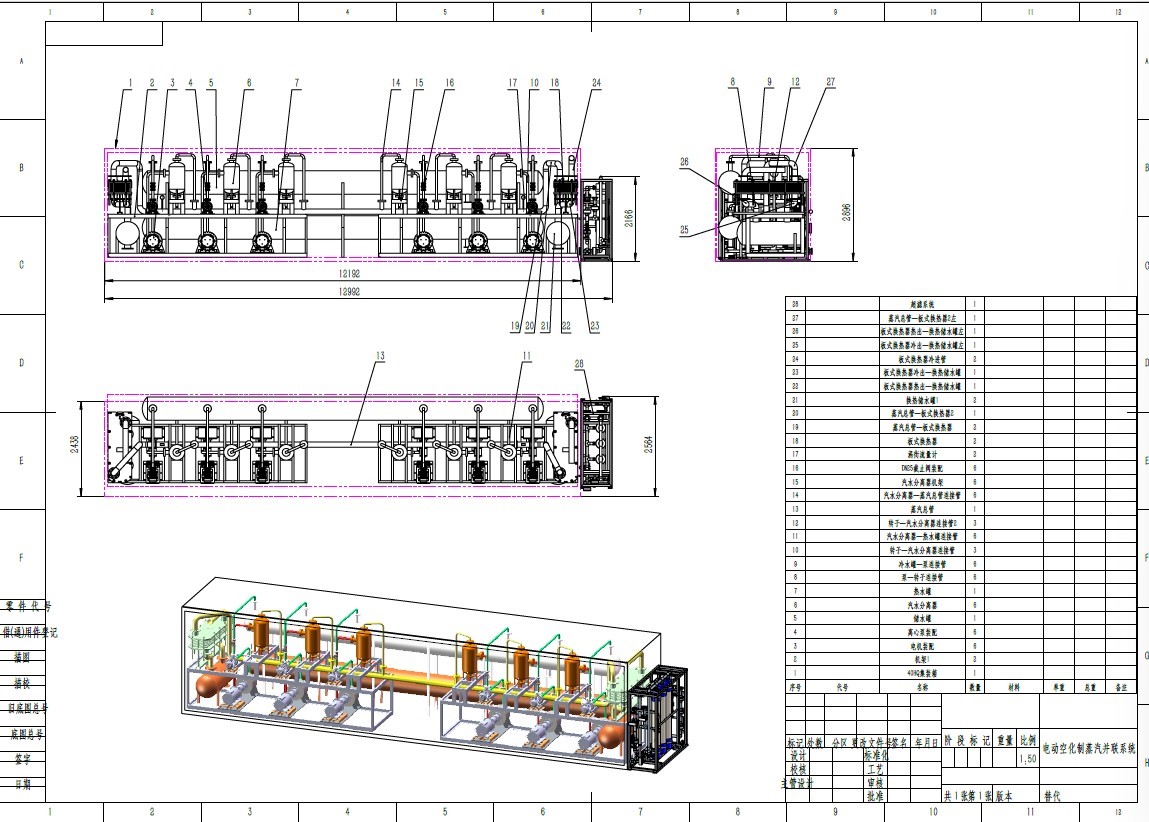
Total Steam Output
Steam output per unit: 2 t/h, total 6 units
Total steam output = 6 × 2 = 12 tons/hour clean steam
Total Power Consumption
Motor power per unit: 120 kW, total main motor power for 6 units: 6 × 120 = 720 k
Supplementary note: 720 kW is the rated power of main drive motors. The whole system also consumes auxiliary power for pre‑treatment pumps, condensation circulating pumps and control system, with auxiliary power of approx. 40-60 kW. The total power consumption of the full load unit is approx. 760-780 kW.
Specific power consumption for steam generation: approx. 60 kWh per ton of steam for main motors; approx. 63-65 kWh per ton of steam for the complete system including auxiliary equipment.
Advantages Compared with Conventional RO Seawater Desalination
Feed Water Quality Adaptability (Core Difference)
Cavitation steam‑generation (this solution): Phase change distillation principle
Seawater /high‑salinity wastewater is directly converted into steam via cavitation shearing, and fresh water is obtained after steam condensation. It is not limited by feed‑water salinity. It can treat ordinary seawater, ultra high salinity brine, RO concentrate and industrial high salinity wastewater. Feed water TDS can reach above 120000 mg/L. Brine can be concentrated to near saturation to realize near zero liquid discharge. High quality distilled water is produced with product water TDS<10 mg/L.
Reverse Osmosis (RO): Membrane sieving filtration
Restricted by membrane pressure resistance, conventional seawater RO can only treat seawater with TDS around 35000 mg/L. Multi‑stage high pressure RO is required for high‑salinity feed water, leading to sharp cost increase. It can hardly handle water with salinity over 70000 mg/L. RO generates large volume of concentrate which must be discharged externally and deep concentration cannot be achieved.
Feed‑water Pre‑treatment Requirements
Cavitation steam generation: Only simple filtration for large particle impurities is required. Strict SDI reduction and antiscalant dosing are not needed. It resists scaling caused by calcium, magnesium and silicon, and has high tolerance for seawater and suspended solid containing wastewater.
Reverse Osmosis (RO): Strict feed‑water requirements. Flocculation, ultrafiltration and antiscalant dosing are mandatory with strict SDI control. Membrane elements will fail once scaled or fouled by colloids, resulting high chemical and O&M cost.
Energy Consumption Characteristics
Cavitation steam‑generation: The power consumption of this system is higher than conventional seawater RO (conventional seawater RO consumes 3-4 kWh/m³ product water). Nevertheless, RO is only suitable for ordinary seawater. When treating high salinity concentrate, energy consumption of high‑pressure RO rises sharply, whereupon cavitation steam-generation shows prominent comprehensive advantages. This unit can be connected to external solar PV for off-grid island applications, and PV power can offset part of grid power consumption.
Operation & Maintenance and Reliability
Cavitation steam-generation: No membrane elements, no periodic membrane replacement cost. Main wearing parts are mechanical seals and pump components. Suitable for high‑salinity wastewater treatment on islands and remote non-chemical sites.
Reverse Osmosis: Membrane elements require batch replacement every 2-5 years. Membranes are vulnerable to damage by chlorine, microorganisms and heavy metals in seawater environment, requiring continuous chemical dosing.
Product Output Form
This unit: High-temperature clean steam for dual purposes:
① Steam condenses to produce distilled water;
② Steam is directly exported as heat source for industry and drying, realizing dual utilization.
Reverse Osmosis: Only ambient‑temperature fresh water is produced without heat output.
Concentration & Zero-Liquid-Discharge Capacity
Cavitation steam‑generation: Continuous concentration is available to produce saturated brine for direct salt crystallization, suitable for zero-liquid-discharge projects of high‑salinity wastewater.
RO only achieves limited concentration; concentrate must be discharged and true zero-liquid-discharge cannot be realized.
Application Scenarios
- Remote islands: PV + container‑integrated seawater desalination, supplying both fresh water and heating steam;
- Offshore platforms: high‑salinity wastewater treatment;
- Industrial high-salinity wastewater and RO concentrate volume reduction for zero-liquid-discharge;
- Agricultural product drying and salt-making projects: producing fresh water as well as process steam.
Prototype Performance Test Data
Test condition: The prototype runs continuously at full‑load for 72 hours. Feed water is simulated seawater with feed-water TDS: 36500 mg/L, ambient temperature 25℃.
Test Item |
Design Value |
Prototype Measured Value |
Unit |
Single‑unit motor input power |
120 |
117‑122 |
kW |
Steam output per unit |
2 |
1.92‑2.05 |
t/h |
Total steam output of complete unit |
12 |
11.5‑12.3 |
t/h |
Total system power consumption (all auxiliaries included) |
760‑780 |
752‑785 |
kW |
Specific power |
63‑65 |
62.1‑66.4 |
kWh/t‑steam |
TDS Product water (steam condensed) TDS |
<10 |
2.6‑7.4 |
mg/L |
TDS Max allowable feed‑water TDS |
120000 |
118000 |
mg/L |
Continuous stable operation |
- |
72 |
h |
| System scaling status | No obvious scaling | No obvious calcium magnesium silicate scaling was observed |
Under full-load condition, the prototype achieves design targets in steam output, power consumption and product water quality. The equipment shows excellent anti-scaling performance for high-salinity feed water without antiscalant dosing. Condensed distilled water has superior quality, suitable for process water and domestic water supply. It adapts to island projects and zero‑liquid‑discharge of high-salinity wastewater.
Test condition: Feed water is RO concentrate with TDS 72000 mg/L
Test Item |
Measured Result |
Unit |
Final concentrated brine TDS |
108000 |
mg/L |
Concentration ratio |
1.5 |
‑ |
Product water TDS |
3.8‑8.1 |
mg/L |
| Operation status | Stable operation without severe scaling |
The unit can directly treat RO concentrate for further volume reduction, suitable for wastewater near‑zero‑liquid‑discharge projects.
Summary of Key Parameters
Item |
Value |
Container specification |
40‑foot standard container skid‑mounted |
Number of cavitation modules |
6 sets in parallel |
Motor power per unit |
120 kW |
Steam output per unit |
2 t/h |
Total steam output of complete unit |
12 t/h |
Total rated power of main motors |
720 kW |
Total full‑load power consumption (including auxiliaries) |
760‑780 kW |
Product water quality |
TDS<10mg/L Distilled water, TDS<10 mg/L |
Allowable feed‑water TDS |
Up to 120000 mg/L |